The NBA Achilles Crisis

The real problem is not workload, it is modern training, modern movement, and the league’s loosened rules that push players into unsafe mechanics.
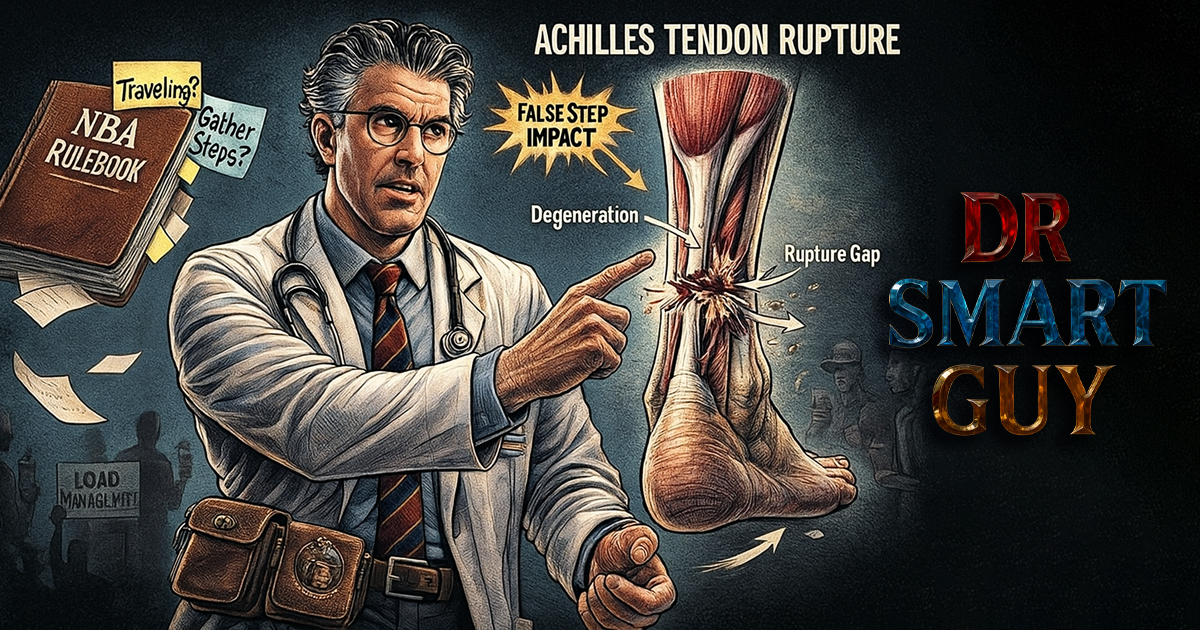
People keep insisting, and it rarely gets challenged, that the NBA Achilles rupture problem is about “workload.” Minutes, game count, back-to-back games, travel. But this explanation collapses instantly once you step outside NBA logic and look at how the human body performs in other high-intensity sports.
Before getting to the biomechanics, here’s the uncomfortable truth: NBA players do not play too many minutes. They play fewer minutes, at a lower intensity, with more rest and more money than almost any other elite athletes on Earth, and this is true not only when compared to other current sports, but also when compared to earlier generations of NBA players who trained harder, practiced more, and played through far more demanding physical environments.
Yet they’re the ones blowing out Achilles tendons at historic rates. Last season produced eight ruptures, the most ever, almost all in the exact same movement pattern.
The mechanism is well-documented: the “false step,” where a stationary player drops the back foot and explodes forward, often into a very low ankle angle. Almost all ruptures occur at roughly the same biomechanical breakpoint. And almost every tendon shows pre-existing degeneration.
This part is correct. What I reject completely is the league’s obsession with “game load” as the culprit.
NBA Workload Is Not High, It’s Historically Soft
The reality is hard to ignore.
NBA players sweat less today than YMCA players do in their nightly pickup runs.
People of all ages at a YMCA routinely play 2–3 hours straight, with no load management, no minute restrictions, no soft-tissue “risk modeling.” And they aren’t world-class athletes.
Soccer players run continuously for 90+ minutes, multiple matches per week, with real training sessions between them, not the curated boutique workouts NBA players do today. Tennis pros play eleven months a year. Marathoners, combat athletes, and cyclists all load their bodies at levels far beyond NBA demands.
Yet we’re supposed to believe whether a star played 35 or 37 minutes is the great biomechanical tipping point?
That is not sports science. That is brand protection masquerading as physiology.
And let’s be clear: today’s NBA players barely practice in the traditional sense. They don’t do long, punishing team sessions. They don’t build load tolerance through repetition. They mainly do personal shooting work, light choreography, and weight-room aesthetics.
This points directly to the actual problem.
The Real Culprit: The Way Modern Players Train
When you avoid long, grueling basketball practices, the kind that build tendon density and movement variation, and replace them with:
- isolated shooting routines
- aesthetic-focused weightlifting
- high-repetition narrow-skill work
- minimal defensive and contact reps
you end up with highlight athletes who are poorly conditioned for the violent, awkward angles that the modern NBA now demands. Research in applied biomechanics shows that tendons experience their highest stress under rapid low-angle push-off1. Studies in the Journal of Applied Physiology and the Royal Society Interface describe this pattern, where reduced ankle angle produces a nonlinear spike in Achilles tension.
Tendons adapt to the load you put on them. Today’s load is narrow, repetitive, and not functional. The degeneration noted in nearly every ruptured tendon is a predictable outcome of modern training culture.
But degeneration alone isn’t enough. Something must pull the trigger.
That “something” is the modern, rule-bending style of movement.
The Modern NBA Encourages Biomechanically Dangerous Movements
There is a structural flaw the league prefers not to address: The NBA stopped enforcing traveling.
When players can:
- slide the pivot foot
- pick the ball up after stepping
- take multiple gather steps
- execute ultra-low-angle push-offs that weren’t legal in older basketball
they repeatedly place the Achilles into its most dangerous loading position, the same sub-48-degree ankle angle associated with ruptures.
If the league enforced the historical pivot rule — “you cannot move your pivot foot before the dribble” — half of these biomechanical extremes vanish overnight.
But that’s not all. Modern foul-baiting transforms basketball footwork into contortionism:
- flailing for contact
- unnatural lean-backs
- off-balance landings
- awkward torque angles to sell a whistle
Biomechanics research shows that off-axis loading and evasive or contact-seeking motions increase shear forces on the Achilles and raise rupture probability23. These movements are monetized distortions created by a league that rewards theatrics. Tendons are not designed to handle that as a daily workload.
Older eras forced more natural, linear, grounded basketball movement. Natural movement is safer. Unnatural movement is not.
The NBA’s Rule Environment Is Directly Making Players Less Safe
There is also a human element that gets lost in the criticism. It is easy to label modern players pampered or overprotected, but most are simply operating inside an ecosystem that rewards the movements that put them at risk. They do not want catastrophic injuries. They are not choosing to damage their tendons. They are responding to incentives created by the league, officiating trends, and a culture built around scoring and highlights.
These athletes have life-changing financial security, but that does not mean they possess the knowledge needed to protect themselves from mechanics the league quietly permits. If traveling and foul-baiting create unsafe angles, players cannot reasonably be expected to avoid those actions while the rules reward them. Still, if players understood how directly these gimmicks contribute to injuries, some might push back or even advocate for a return to cleaner, safer rules.
Here is the core argument:
If you enforce old-school footwork and foul standards, Achilles injuries decline, not because players magically get stronger, but because the movements that blow out tendons would no longer be legal.
This is not nostalgia. It is biomechanics.
The false-step angle that ruptures tendons exists because modern players are allowed to execute low-angle torque maneuvers that used to be violations. The league did not evolve to be safer; it evolved to be more "spectacular" (superficially, at least), and the body is paying the price.
The Synthesis: Achilles Ruptures Are a Modern NBA Manufacturing Defect
When you combine:
- Soft workload culture compared to every other sport
- Minimal real practice and narrow, non-functional training
- Modern travel allowances enabling dangerous push-off mechanics
- Foul-baiting that forces unnatural body angles
- Tendons already weakened by repetitive, aesthetic-driven workouts
you get exactly what we are seeing:
a league-wide wave of catastrophic tendon failures, but only in this league and only in this era.
Workload is not the problem. Minutes are not the problem. Games are not the problem.
The modern NBA rulebook and training culture are the problem.
Return strict footwork. Return proper foul standards. Return real basketball movement.
Injuries will drop, not because players rest more, but because the sport will move away from movements science has repeatedly shown to be structurally unsafe.